Revive Customer Engagement with AI Automation
Customer Engagement, AI Automation, Sales Growth
Why Customers Stop Responding (And What You Can Do About It)
Learn why prospects and customers suddenly go silent—and how AI automation, AI voice agents, AI chatbots, AI CRM, and business automation can systematically bring conversations (and revenue) back to life.
Imagine this: your sales team finally gets a warm inbound lead. Great discovery call, clear next steps, proposal sent on time. Then… nothing. No reply to follow-ups. No feedback. Just silence.
If you run a clinic in Singapore, an insurance agency in Mumbai, a real estate firm in Dubai serving US investors, or a contractor in Texas—you’ve seen this movie before. The question is not if customers stop responding. It’s why they disappear and what you can do about it without burning out your team.
In 2026, the companies winning the engagement game are not sending “more emails” or “calling harder.” They’re quietly using AI automation, AI voice agents, AI chatbots, AI CRM, and end-to-end business automation to keep conversations alive—24/7—across channels and time zones.
Why Customers Stop Responding: The Real Reasons (Not the Excuses)
Here’s what most businesses don’t realize: silence is rarely about you personally. It’s almost always about friction, timing, and relevance. Across Singapore, India, and the US, we see the same patterns repeating:
They feel overwhelmed. Inboxes are flooded. WhatsApp is noisy. Your message is just one more notification competing with a hundred others.
Your follow-up isn’t relevant enough. Generic “Just checking in” messages don’t move busy decision-makers. They respond to specific value, not vague nudges.
The timing is off. You follow up when they’re in a meeting, on a site visit, or putting kids to bed. By the time they’re free, your message is buried.
Your process creates micro-friction. “Can you fill this form?”, “Can you email us back?”, “Can you call this number?” Every extra step is a chance to drop off.
They don’t want to say “no.” Many prospects would rather go silent than send a direct rejection. Silence feels easier than confrontation.
Forbes notes that customers often stop responding when communication becomes overwhelming and not personalized enough. At the same time, Gartner and McKinsey highlight that brands that fail to adapt their engagement to customer behavior will see increasing disengagement over the next few years.
The 2026 Reality: The Engagement Divide Is Getting Worse
Medallia’s 2026 State of Customer Experience report found that 66% of CX leaders think their experience improved, but only 17% of customers agree. That’s a massive gap—the “Engagement Divide.”
At the same time, 81% of consumers now see AI as part of modern customer service. But there’s a catch: Braze reports that while 93% of marketers think AI helps them understand customers, only 53% of consumers actually feel understood. That’s the “Trust Gap.”
Translation? Technology alone doesn’t fix silence. What fixes it is the right mix of:
Intelligent AI automation that removes friction and follows up at the right time, on the right channel.
AI voice agents and AI chatbots that feel human, not robotic—and know when to hand off to your team.
An AI CRM that actually remembers every touchpoint and orchestrates the next best action automatically.
💡 Quick insight: Leading CX performers are seeing up to 26% higher revenue growth by building AI-first engagement flows that respond in real time—not in “office hours.”
Why Customers Stop Responding: A Simple Definition You Can Act On
Customer non-response is when a prospect or customer stops engaging with your messages—email, WhatsApp, SMS, calls, or social—after initial interest. It’s usually a sign of mismatch between what they need in that moment and how, when, and where you’re communicating.
Enter AI Automation: Turning “We Should Follow Up” Into “It’s Already Done”
AI automation is not about replacing your sales or marketing team. It’s about removing the manual, repetitive, easily-forgotten tasks that cause leads to slip through the cracks. Think of it as a tireless digital coordinator that:
Tracks every lead from first click to closed deal inside an AI CRM.
Triggers smart follow-ups via AI chatbots, email, or WhatsApp based on behavior (opened, clicked, visited pricing page, abandoned form, etc.).
Uses AI voice agents to call leads who haven’t replied and politely re-engage them—at scale.
For SMEs, this is where Nexurate Technologies comes in: AI automation, AI voice agents, AI chatbots, and AI CRM working together as one business automation layer that quietly protects your pipeline 24/7.
How AI Voice Agents, AI Chatbots, and AI CRM Actually Work (In Simple Terms)
AI Voice Agents: Your Always-On, Always-Polite Call Team
An AI voice agent is a smart, natural-sounding digital caller. It can:
Call leads who filled a form but never picked up your first call.
Confirm appointments for clinics, site visits for real estate, or policy renewals for insurance—without your staff dialing manually.
Answer basic questions (“Where is your clinic?”, “What documents do I need?”, “What’s the next step?”) and escalate complex cases to a human instantly.
Because it’s powered by conversational AI, it can understand accents across Singapore, India, and the US, respond in natural language, and update your AI CRM in real time after each call.
AI Chatbots: Instant Answers Before Silence Sets In
An AI chatbot is your 24/7 digital front desk on your website, WhatsApp, or social channels. It:
Responds instantly when someone asks about pricing, availability, or next steps—before they bounce to a competitor.
Qualifies leads by asking a few smart questions, then routes high-intent prospects to your sales team with full context.
Follows up automatically when someone abandons a form or stops mid-conversation: “Hey, want to pick this up where we left off?”
AI CRM: The Brain Behind Your Business Automation
A traditional CRM is a database. An AI CRM is a decision engine. It doesn’t just store contacts; it analyzes behavior and recommends (or triggers) the next step. For example:
If a prospect opens your proposal three times but doesn’t reply, the AI CRM can trigger an AI voice agent to call with a specific script: “Hi, I saw you reviewed the proposal—do you have any questions I can clarify?”
If a clinic patient hasn’t booked a follow-up in 6 months, it can send a personalized WhatsApp reminder with available slots and a one-click booking link.
This is what business automation looks like in practice: every touchpoint orchestrated intelligently, instead of random manual follow-ups when someone remembers.
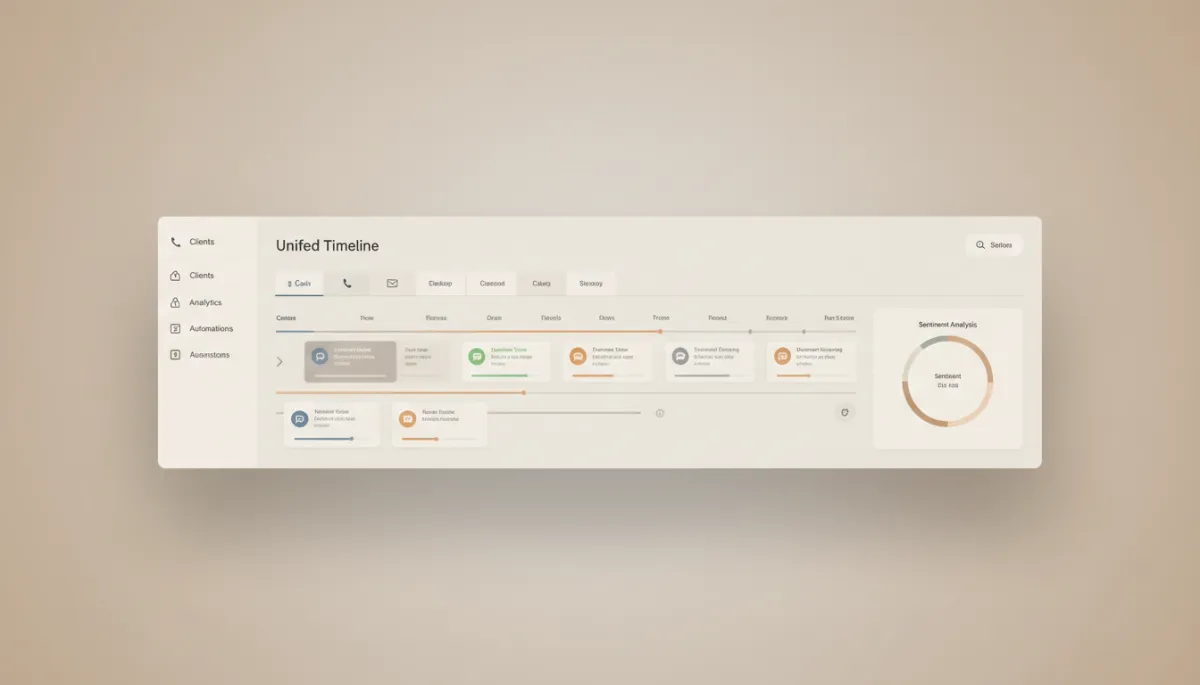
A unified AI CRM view turns scattered touchpoints into predictable, automated follow-ups.
Mini Scenario: How a “Silent” Lead Turned Into a 6-Figure Deal
Imagine this: a mid-sized real estate agency in Singapore attracting overseas buyers from India and the US. A high-net-worth prospect fills out a form about a new launch, books a call, attends… and then goes quiet after receiving the investment deck.
In the old world, the salesperson might send 2–3 follow-up emails, maybe a WhatsApp ping, then move on. Revenue lost, pipeline “dead.”
With Nexurate-style AI automation in place, here’s what happens instead:
The AI CRM detects that the prospect opened the deck twice and clicked on units above a certain price point but didn’t reply within 48 hours.
An AI chatbot sends a personalized WhatsApp: “Hi Alex, noticed you explored the 3-bedroom units. Would you like updated availability or rental yield projections?”
When there’s still no response, an AI voice agent calls at a time window when similar prospects usually answer (based on historical data), saying: “Hi Alex, this is the concierge team for the Marina View project. We’ve reserved a few units matching what you viewed—would you like a quick 5-minute update?”
Alex presses 1 to connect. The call is instantly routed to the right salesperson with full context on screen. No awkward small talk, just straight into value.
The result? A deal that would have died in silence becomes a six-figure sale. Not because the salesperson worked harder, but because the system followed up smarter.
Tangible Benefits: What This Means for Your Business in Numbers
More conversations from the same leads. Intelligent AI follow-ups can re-activate 15–30% of “silent” leads, depending on industry and region.
Faster response, higher close rates. AI chatbots and AI voice agents respond in seconds, not hours. In many markets, responding within 5 minutes can double conversion rates compared to waiting a day.
Lower cost per sale. By automating routine calls and messages, your human team focuses only on high-value conversations. That means lower acquisition cost and higher ROI on ad spend.
Predictable revenue. With business automation, you move from “hope we remember to follow up” to “we know every lead is nurtured properly across 30, 60, 90 days.”
📌 Key takeaway: You don’t need more leads. You need fewer leads going silent—and AI automation is the fastest way to get there.
Common Objections (And Why They’re Costing You Revenue)
“Won’t AI make us feel less human?”
Not if it’s done right. The goal is not to replace your best people. It’s to free them from repetitive work so they can be more human where it matters—complex deals, sensitive cases, high-value clients. Remember, customers are already interacting with AI in banking, travel, and e-commerce. They care less about “Is this AI?” and more about “Did I get a fast, useful, respectful response?”
“We’re an SME. Isn’t this overkill for our size?”
In 2026, AI automation is no longer a “big enterprise toy.” It’s becoming the only realistic way for SMEs in Singapore, India, and the US to compete with larger players who can afford big teams. The right partner (like Nexurate) will help you start lean—one or two high-impact workflows—and scale as you see ROI.
“Will my team be able to manage all this tech?”
A well-designed AI CRM and automation layer should feel simpler than the spreadsheets and disconnected tools you’re using today. Your team logs into one place, sees one timeline per customer, and the system takes care of the heavy lifting. Nexurate’s implementations are built specifically for sales and marketing teams—not for developers.
What You Can Do About Silent Customers—Starting This Quarter
Step 1: Map Where Silence Happens
After first inquiry?
After proposal or quote?
After first purchase (no repeat)?
Step 2: Automate One High-Value Follow-Up Flow
For clinics: missed appointment reminders and follow-up care messages via AI chatbot and SMS.
For insurance: renewal reminders and policy upgrade suggestions via AI voice agent and email.
For contractors: quote follow-ups with project timelines and FAQs handled by AI chatbot on your website.
Step 3: Plug It All Into an AI CRM
This is where Nexurate’s AI CRM and business automation come together. Every call, chat, email, and WhatsApp is tracked. Every “silent” customer triggers a smart, respectful, automated sequence designed to re-open the conversation—without your team having to remember a thing.
💬 Want to see this live? Book a free AI voice agent and chatbot demo with Nexurate and watch how quickly we can turn your silent leads into active conversations.
FAQ: Why Customers Stop Responding (And How AI Automation Helps)
1. Why do customers suddenly stop responding after showing interest?
Most customers stop responding because of overload, poor timing, or low perceived relevance—not because they hate your product. They get busy, your message gets buried, or your follow-up doesn’t clearly add value. AI automation helps by sending context-aware, well-timed follow-ups across channels so you stay top-of-mind without being pushy.
2. How can AI voice agents reduce customer silence?
AI voice agents can call leads who haven’t replied, confirm appointments, and answer basic questions automatically. They reach out at optimized times and use natural language, making it easy for customers to re-engage with a simple voice response or keypad input. When the conversation becomes complex, they hand off to your human team with full context.
3. What’s the difference between a basic chatbot and an AI chatbot?
Basic chatbots follow rigid scripts and often frustrate users. An AI chatbot understands natural language, remembers context, and can personalize responses based on previous interactions and CRM data. It can qualify leads, answer complex FAQs, and trigger the right follow-up actions automatically—significantly reducing drop-offs and silence.
4. How does an AI CRM help with non-responsive leads?
An AI CRM tracks every interaction and uses that data to predict and automate the next best action. If a lead goes quiet, it can automatically launch a tailored sequence involving emails, AI chatbot nudges, or AI voice calls designed to re-open the conversation at the right moment, on the right channel.
5. Is AI automation suitable for SMEs in Singapore, India, and the US?
Yes. In fact, SMEs benefit the most because they typically have limited sales and support headcount. AI automation lets you punch above your weight—following up like a 50-person team while keeping your actual team lean. Nexurate’s solutions are built specifically with SME realities in mind: fast deployment, clear ROI, and minimal complexity.
6. What kind of ROI can I expect from AI-powered business automation?
While exact numbers vary, businesses implementing AI-first customer engagement often see 15–30% more deals from the same lead volume, faster sales cycles, and significant time savings for their teams. The biggest ROI comes from reactivating “dead” leads, reducing manual work, and protecting every marketing dollar you already spend.
Ready to Turn Silence Into Sales? Here’s Your Next Step.
If you’ve read this far, you already know the truth: your biggest growth opportunity isn’t just “more leads.” It’s fixing why customers stop responding and building an AI-powered system that keeps conversations alive—intelligently, respectfully, and at scale.
Nexurate Technologies helps SMEs across Singapore, India, and the US deploy AI automation, AI voice agents, AI chatbots, AI CRM, and end-to-end business automation that align with how modern customers actually behave in 2026—not how they behaved five years ago.
Here’s your low-friction next move: book a live AI call and chatbot demo with Nexurate. We’ll walk through your current engagement gaps, show you exactly where customers are going silent, and map a practical automation plan you can implement in weeks, not months.
Because in 2026, the question isn’t “Will customers stop responding?” They will. The real question is: Do you have the AI-powered systems in place to bring them back? With Nexurate, the answer can be yes—starting now.
Title: Why Customers Stop Responding (And How AI Wins Them Back)
Description: Discover why customers go silent and how AI automation, AI voice agents, chatbots, and AI CRM from Nexurate can re-engage leads and grow revenue.
