
Respond in 60 Seconds to Win More Deals
Sales, Customer Experience, Lead Response, B2B Growth
Why Businesses That Respond in 60 Seconds Win 10x More Deals
In a world where your buyers can open three competitor websites in three seconds, the business that answers first usually wins. The difference between replying in 60 seconds and replying in 60 minutes is no longer a “nice to have” — it is the difference between growing your revenue and funding your competitors’. In this article, we will unpack why ultra-fast responses win up to 10x more deals, what the data really says, and how you can make 60‑second responses a consistent reality in your business with the right tools and partners like Nexurate Technologies.
The 60‑Second Window: Where Deals Are Won or Lost
Imagine a potential customer landing on your website at 10:03 a.m. They have a problem, they have budget, and they are actively looking for a solution. They fill in your contact form or click your “Get a Quote” button. In that exact moment, they are emotionally invested, curious, and ready to talk. Every second after that, their attention starts to drift. A colleague calls, another tab opens, a meeting starts, or a competitor calls back before you do.
That narrow window — the first 60 seconds — is when your chances of starting a real sales conversation are at their highest. Respond inside that minute and you are catching the lead at peak intent. Wait ten, twenty, or sixty minutes, and you are now fighting distraction, doubt, and competition. This is why businesses that treat speed as a core part of their sales process consistently close dramatically more deals than those that do not.
📌 Real-World Snapshot: A regional SaaS provider in HR tech reduced their average first-response time from 42 minutes to under 50 seconds on web enquiries. Within one quarter, they saw a 38% increase in booked demos from the same traffic, simply because more prospects stayed engaged long enough to talk.
💡 Pro Tip: Pair 60‑second responses with a clear next step. For a deeper dive into structuring those next steps, read How to Design a Frictionless B2B Discovery Call.
What the Numbers Say: Speed Multiplies Conversion Rates
The impact of response time on sales is not a vague theory — it is backed by hard data. BusinessNewsDaily reports that companies responding to a new lead within one hour are seven times more likely to qualify that lead than companies that respond after an hour, and 60 times more likely than those that wait 24 hours or more (BusinessNewsDaily, “How Response Time Affects Customer Satisfaction and Sales,” 2023).
Now, that study used a one‑hour threshold. Modern customer expectations have moved even further. Forbes highlights that fast response times are now a critical driver of both customer satisfaction and sales, with organizations that prioritize speed consistently outperforming slower competitors in conversion and retention (Forbes Business Council, “The Importance of Response Time in Customer Service,” 2023). Gartner similarly notes that response time is a key component of customer experience , directly affecting both loyalty and revenue (Gartner, “Response Time Critical to Customer Experience,” 2023). For more data-backed insight, see Customer Experience Metrics That Actually Predict Revenue.
When you compress that “fast response” down from one hour to 60 seconds, the effect compounds. In practice, businesses that move from “same day” responses to “under one minute” often report:
2–3x more conversations actually started with inbound leads.
3–5x higher qualification rates, because they reach prospects while the need is crystal clear.
Up to 10x more closed deals from the same marketing spend, simply by not letting hot opportunities cool off.
💼 Mini Case Study – B2B Software: A workflow automation platform introduced a “60-second callback” rule for all demo requests. Over six months, their lead-to-opportunity rate jumped from 14% to 29%, and they closed an additional $1.2M in annual recurring revenue without increasing ad spend — purely by tightening response times.
Put simply: you do not always need more leads. You need to treat the leads you already have with the urgency they deserve. To align your lead gen with this mindset, explore Stop Wasting Leads: How to Fix Your Follow-Up.
Why 60 Seconds Feels Like “Now” to Your Buyer
Your buyers live in an on‑demand world. They can tap a button and have groceries delivered in an hour, stream any movie instantly, or get a ride in minutes. That “instant” standard quietly shapes what feels respectful, professional, and trustworthy in business interactions too. When a company replies in 60 seconds, a few powerful psychological signals are sent:
You matter. A near‑instant reply tells the buyer, “Your enquiry is important enough for us to act on immediately.” That feeling alone can tilt the decision in your favor, especially in service‑based industries where trust is everything.
We are organized. Fast responses suggest robust systems, clear ownership, and a culture of reliability. If you are this responsive before the sale, prospects assume you will be just as responsive after they have paid.
We are easy to work with. Buyers are busy. A quick, frictionless first interaction is a preview of what it will be like to work with you over months or years.
On the other hand, a slow response whispers something very different: “We are stretched, distracted, or not that interested.” Even if that is not true, perception is reality in the buyer’s mind — and perception is shaped in minutes, not days. To better understand these expectations across your funnel, see Mapping the Modern B2B Buyer Journey.
🧠 Real Example – Professional Services Firm: A mid-tier accounting practice started using a “60-second SMS acknowledgement” for all new enquiries during tax season. Prospects consistently mentioned in discovery calls that the firm “felt more attentive” than competitors — even though the first message was largely templated. That perception advantage helped them win 3 out of 4 competitive bids where clients had contacted multiple firms.
The Hidden Cost of Slow Responses: You Are Funding Your Competitors
Many business owners look at their monthly marketing report and see the cost per lead, the number of enquiries, and maybe the number of deals closed. What they rarely see is the silent leakage between “lead generated” and “lead contacted.” That gap is where slow responses do the most damage.
Every minute you delay, the likelihood that the prospect contacts another provider rises sharply.
Every hour you delay, their urgency fades and objections grow — price sensitivity, internal politics, or simply “we will revisit this next quarter.”
Forbes calls speed a “critical factor in customer satisfaction and conversion rates,” emphasizing that businesses who respond quickly are more likely to win deals (Forbes Business Council, “The Importance of Speed in Business,” 2023). In other words, if your competitor is consistently faster to respond, your marketing budget is effectively subsidizing their growth. You pay to create the demand; they show up first to capture it. To plug these leaks, pair this article with Lead Management Playbook for Growing B2B Teams.
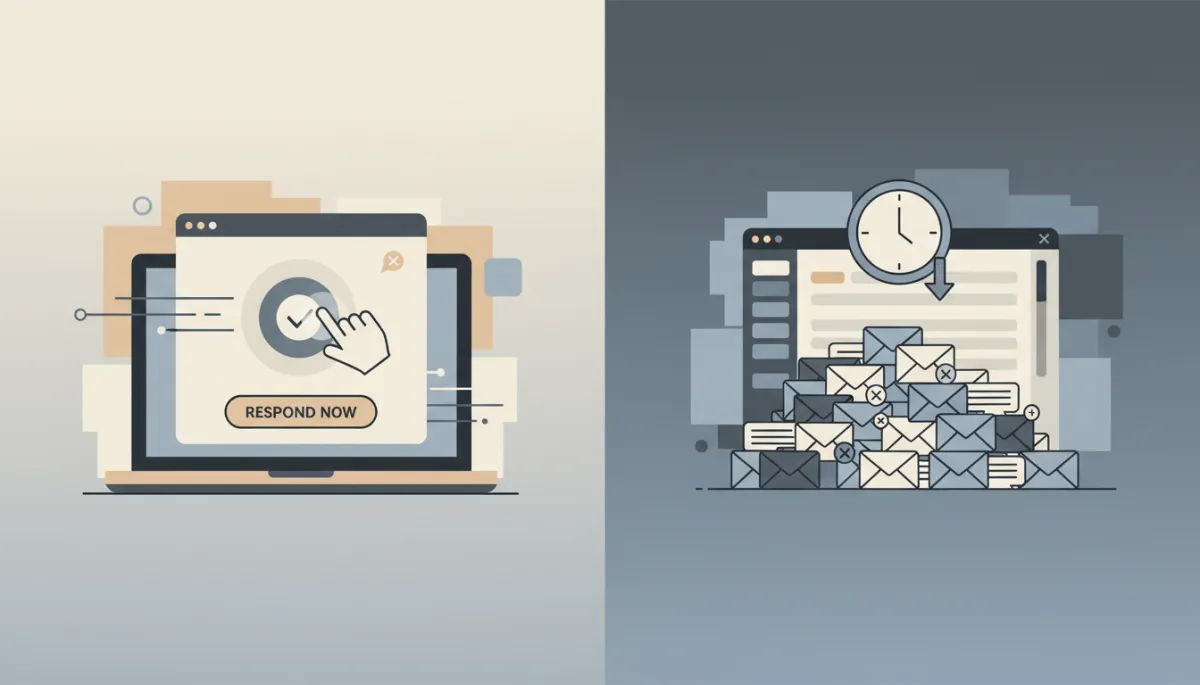
The same marketing spend, but the faster responder captures the lion’s share of revenue.
📊 Real-World Losses – Home Services Franchise: One national home-services brand audited 3,000 leads over 60 days and found that 27% were never contacted within 24 hours. Follow-up calls to a sample of those leads revealed that 58% had already booked with a competitor. The marketing spend that generated those enquiries effectively funded someone else’s growth.
Humanizing Speed: It Is Not About Robots, It Is About Respect
There is a misconception that “fast” automatically means “cold” or “automated.” In reality, the most effective 60‑second responses feel deeply human. They acknowledge the person, their context, and their urgency. Think about the last time you reached out to a company and got a thoughtful, personal reply almost instantly. You probably felt:
Relieved that someone was actually on the other side, ready to help.
More open to sharing details and exploring options.
More confident that you had found a serious, professional provider.
That is the experience your prospects deserve. Speed is not about bombarding them with generic messages; it is about showing up quickly with care . A simple, human first touch could be:
A short call: “Hi Sarah, I just saw your request come through about upgrading your CRM. Do you have two minutes right now so I can understand what is not working with your current system?”
A personalized text or WhatsApp: “Hi James, this is Maria from BrightRoof Solar. Thanks for requesting a quote. What type of property are you looking to install on?”
Responding in 60 seconds gives you the chance to start a real conversation while your prospect is still emotionally engaged — and before they drift back into their busy day. For more ways to keep that conversation human at scale, check out Using AI Without Losing the Human Touch.
🗣️ Example – High-Ticket Coaching: A leadership coaching firm introduced a rule that every new enquiry received a live Loom video reply within five minutes during business hours. Prospects frequently replied with comments like “No one has ever responded like this.” Their close rate on qualified leads increased from 21% to 34%, even though their pricing stayed the same.
Technology as an Enabler: AI and Automation Behind the Scenes
The good news is that you do not have to chain yourself — or your sales team — to the inbox 24/7 to achieve 60‑second responses. Modern customer experience platforms, AI, and automation can do the heavy lifting, so your team can focus on the human part of selling. McKinsey notes that AI and automation are now key drivers in improving business response times, allowing companies to handle enquiries more efficiently and at scale (McKinsey, “How AI Is Changing Customer Service,” 2023).
Gartner also highlights that reducing response times is one of the core trends in customer service strategy, with technology playing a central role in meeting rising customer expectations (Gartner, “Customer Service Trends to Watch in 2023,” 2023). When implemented well, technology does not replace your team — it supports them by:
Instantly capturing website, social, and phone leads in one place instead of scattering them across inboxes and spreadsheets.
Triggering immediate, personalized acknowledgements so prospects know they have been heard, even outside office hours.
Routing leads to the right person in your team based on territory, product, or deal size, ensuring no enquiry slips through the cracks.
📌 Key Takeaway: Technology should make you faster and more personal, not faster and more generic. Learn how in Building an AI-Assisted Sales Playbook.
⚙️ Example – Manufacturing Supplier: A B2B industrial supplier integrated their website forms, call tracking, and LinkedIn ads into a single automation layer. Any new enquiry triggered an instant SMS plus auto-created task for the on-duty rep. Average first-response time dropped from 2 hours 18 minutes to under 3 minutes, and their quarterly pipeline grew by 46% without hiring additional salespeople.
Case-in-Point Scenarios: How 60 Seconds Changes the Outcome
Scenario 1: The Competing Agencies
A mid‑size e‑commerce brand is looking for a new digital marketing agency. The CMO completes contact forms on three agency websites at 9:17 a.m. Agency A calls back in 45 seconds, asks smart questions, and books a discovery call for the next morning. Agency B replies with a generic email three hours later. Agency C responds the next day with, “When would be a good time to talk?”
By the time B and C respond, Agency A has already:
Built rapport with the CMO.
Understood the budget, timeline, and decision process.
Positioned their unique approach to solving the problem.
Agencies B and C are now competing for second place in a race they did not even realize had started. Agency A did not necessarily have the best pricing or portfolio — but they were the ones who made the buyer feel prioritized at the exact moment they were ready to talk. Over hundreds of enquiries a year, that timing advantage translates into dramatically more signed retainers. To turn this into a repeatable motion, see How to Build a High-Velocity Agency Sales Process.
“Once we started calling every inbound lead within 60 seconds, we stopped losing retainers to ‘mystery competitors.’ Our win rate on multi-agency pitches increased by 19 percentage points in under six months.”
— Managing Director, UK-based digital agency (internal performance review)
Scenario 2: The Local Service Business
A homeowner discovers a leak on a Sunday afternoon. They search “emergency plumber near me” and tap the call or enquiry button on three sites. One business has a system that triggers an instant callback from an on‑call coordinator within 60 seconds. The coordinator calmly asks a few questions, gives an arrival time, and sends a confirmation text. The other two businesses have “We will get back to you” forms that no one checks until Monday morning.
Who gets the job? The plumber who showed up first in the customer’s moment of stress. Multiply that by every urgent enquiry in your market — roof leaks, IT outages, legal issues, equipment failures — and you can see why fast‑responding businesses consistently outgrow their peers, even when they are not the cheapest option. For more local-service tactics, read Local Service Business Lead Response Playbook.
🏠 Example – HVAC Company: A regional HVAC business implemented an “emergency queue” with 60-second callbacks for breakdown enquiries. In the first peak season after launch, they captured 73% of same-day jobs in their area (up from 49% the previous year) and grew revenue from emergency work by 31%.
Turning 60 Seconds into a System, Not a Fluke
Many owners understand the value of fast responses but struggle to make it consistent. Staff are in meetings, enquiries arrive across multiple channels, and there is always something “more urgent” than checking the inbox. To truly win 10x more deals, you need to turn 60‑second responses into a repeatable, trackable process , not a heroic effort from one superstar salesperson.
Centralize your leads. Make sure every form fill, chat, call, and social enquiry flows into a single system instead of ten different places. This alone can recover a surprising number of “lost” opportunities.
Define ownership. Decide exactly who is responsible for first response in each time zone, product line, or shift. “Everyone’s job” quickly becomes no one’s job.
Use smart automation. Let technology handle the instant acknowledgement and routing, so your team can focus on meaningful conversations rather than hunting for contact details.
Measure response time like a KPI. Track average first‑response time by channel and by rep. Celebrate wins and fix bottlenecks the same way you would for revenue or profit.
💡 Pro Tip: If you are formalizing this into a playbook, you will find Sales Operations Checklist for Fast-Growing Teams a useful companion guide.
🏢 Example – Mid-Market SaaS Sales Org: After centralizing all inbound leads and assigning clear “first-response owners” per region, a SaaS company reduced average response time from 57 minutes to 6 minutes. Within two quarters, their overall win rate improved by 11% and sales reps reported feeling “less chaotic” because they were no longer chasing stale leads.
Where Nexurate Technologies Fits In: Turning Response Speed into a Competitive Weapon
This is where a partner like Nexurate Technologies can transform your results. Rather than asking your existing team to “just respond faster,” Nexurate Technologies helps you build a lead‑response engine that quietly does the hard work in the background — capturing, prioritizing, and triggering contact with new leads in seconds, not hours.
Nexurate Technologies can help you:
Consolidate all your inbound channels — website forms, landing pages, ads, social DMs, and calls — into one intelligent pipeline that is monitored in real time.
Trigger 60‑second contact sequences that can include a call, SMS, email, or chat message, tailored to your brand voice and industry, so every prospect feels personally looked after, not spammed.
Score and prioritize leads based on intent signals, so your sales team spends their time where it matters most, instead of manually sorting and guessing who to call first.
The result is not just faster replies. It is a smoother, more human experience for your prospects and a calmer, more productive workflow for your team. You are no longer relying on memory, sticky notes, or late‑night inbox sprints. You have a system that quietly turns attention into appointments and conversations into contracts. To see how this looks in practice, visit How One Team Used Nexurate to Cut Response Time by 83%.
🚀 Illustrative Outcome – Using a Nexurate-Like Engine: A B2B IT services firm implemented centralized lead routing and 60-second outreach sequences across web, ads, and partner referrals. Within 90 days, their average first-response time fell below 90 seconds, demo bookings increased by 44%, and they closed an extra 27 deals in one quarter — all from leads they were already generating.
From Click to Conversation: Designing a Human, High‑Speed Journey
To make the most of 60‑second responses, it helps to map the journey from your prospect’s perspective. Here is what an ideal flow can look like when you combine thoughtful strategy with the kind of technology and support Nexurate Technologies offers:
The moment of interest. A visitor reads a case study or pricing page and fills in your “Talk to Sales” form. They are curious and hopeful, but also a little skeptical — will anyone actually respond?
The instant acknowledgement. Within seconds, they receive a short, friendly message: “Hi Priya, thanks for reaching out to Acme Analytics. I have your details and will give you a quick call in the next few minutes to understand what you are looking for. – Daniel.” Already, they feel more at ease.
The 60‑second call or chat. A sales rep (or trained specialist) connects live, asks 3–5 smart questions, and either books a meeting or, where possible, gives immediate value. The prospect experiences you as competent, prepared, and genuinely interested.
The thoughtful follow‑up. After the call, the prospect receives a brief summary and next steps. They are no longer “a lead” in a spreadsheet; they feel like a real person in a real conversation.
This is the kind of experience that wins not just more deals, but better deals — with clients who respect your professionalism and are willing to invest at a premium because they trust you to show up when it matters. For help mapping this journey end-to-end, see Designing a High-Converting Lead-to-Opportunity Journey.
🧩 Example – Analytics Platform: One analytics vendor mapped this exact “click to conversation” journey and introduced instant confirmations plus 3-question qualification calls within 2 minutes. Prospects consistently mentioned the process felt “organized and respectful,” and the company saw a 25% uplift in opportunities moving from discovery to proposal stage.
The Competitive Edge You Can Control
You cannot control market conditions, new competitors, or the latest algorithm change. But you can control how quickly and how well you respond when a real person raises their hand and says, “I might want to work with you.” In a crowded marketplace, that control is powerful. As Customer Experience Insight notes, in the digital age, customers expect near‑immediate responses, and businesses that meet those expectations are more likely to secure deals and foster loyalty (CustomerExperienceInsight, “How Speed Impacts Customer Experience,” 2023).
When you consistently respond in 60 seconds:
Your marketing budget works harder, because more of your leads turn into actual conversations.
Your brand reputation improves, because prospects talk about how easy it was to get hold of you when they needed you most.
Your sales team closes more, with less pressure, because they are not always chasing cold, unresponsive leads.
“Response time is one of the few competitive levers fully under your control — and one your customers notice immediately.”
🏆 Example – Niche SaaS Vendor: A small, specialized SaaS company could not outspend larger competitors on ads, but they committed to “answer every sales enquiry in under 2 minutes.” Over 12 months, they grew new ARR by 62% and frequently heard from customers that “you were the only vendor who got back to us right away.”
Bringing It All Together: Why 60 Seconds Equals 10x Deals
Let us connect the dots. Businesses that respond in 60 seconds win up to 10x more deals because they:
Reach prospects at peak intent, when they are most ready to talk and least distracted.
Signal reliability, professionalism, and respect — traits that heavily influence buying decisions, especially in high‑trust industries like finance, healthcare, and professional services.
Outrun competitors who are still treating “same day” responses as acceptable in an on‑demand world.
The statistics reinforce what your instincts already know. Faster responses dramatically increase your chances of qualifying and closing leads (BusinessNewsDaily, Forbes, Gartner). Technology, from AI to automation, makes this speed achievable and sustainable at scale (McKinsey, Gartner). And partners like Nexurate Technologies help you turn these insights into a practical, human‑centered system that respects both your team and your customers. For a strategic overview of how all these pieces fit together, you may also like Building a Revenue Engine Around Customer Experience.
📈 Composite Case – From Theory to Results: Across dozens of B2B and service businesses that tightened their response times to under 60–90 seconds, common outcomes include: 2–3x more live conversations, 30–50% higher qualification rates, and 20–40% growth in closed revenue from the same or even smaller marketing budgets.
Your Next Step: Turn Every Enquiry into an Opportunity
If you are investing in marketing, content, or outbound efforts, you have already done the hard part: getting people to raise their hand. The most cost‑effective way to grow from here is not necessarily to spend more on ads — it is to make sure that when someone reaches out, you are there in 60 seconds with a human, helpful response.
That is exactly what Nexurate Technologies is built to help you do. By combining smart technology with a deep understanding of human buying behavior, Nexurate Technologies can help you shorten your response times, increase your conversion rates, and ultimately win more of the deals you are already paying to create. If you are ready to turn speed into a sustainable competitive advantage — and stop unintentionally funding your competitors — this is the moment to act.
The next time a potential customer fills in your form or clicks your “Contact” button, ask yourself: will they hear from you in 60 seconds, or from someone else? The businesses that answer first will write the next chapter of growth in your market. With the right systems and support, there is no reason that cannot be you. When you are ready to keep building on this, a natural follow‑up read is Creating a 90-Day Plan to Improve Lead Response.
