
AI Voice Agents Cut Healthcare No-Shows by 50%
Healthcare, AI Voice Agent for Healthcare, Clinic Automation
How AI Voice Agents Are Helping Healthcare Clinics Cut No-Shows by 50%
Patient no-shows are more than a scheduling headache. They drain revenue, disrupt care, and overload front-desk teams. In 2026, many clinics are turning to an AI voice agent for healthcare to tackle this chronic problem—often cutting no-shows by 30–50% and unlocking substantial new capacity without hiring more staff.

The Real Cost of Patient No-Shows for Clinics
Across the United States alone, missed appointments are estimated to cost providers around $150 billion annually, with individual physicians losing tens of thousands of dollars each year in unrealized revenue (Innova AI, 2026). While headline figures are eye-catching, the impact inside a single clinic is even more tangible.
Revenue Loss and Unused Capacity
No-show rates vary widely—some medical group benchmarks suggest 5–7%, but many outpatient and specialty clinics experience 15–30% non-attendance. For a practice running 80 appointments per day with a conservative 15% no-show rate, that is 12 empty slots every day. If your average collected revenue per visit is $150, you are leaving roughly $1,800 per day, or more than $400,000 per year, on the table.
This is not just lost income—it is lost opportunity to see new patients, accelerate treatment plans, and reduce waiting lists. Many clinics respond by overbooking, which can backfire when most patients do show up, leading to long waits and clinician burnout.
Wasted Slots and Operational Friction
Every empty appointment slot is a fixed cost without revenue attached. Rooms, equipment, and staff are still scheduled and paid. When a patient does not attend, front-desk teams scramble to:
- Call the patient to reschedule, often leaving voicemails that go unanswered.
- Manually work through waitlists to backfill the slot at short notice.
- Document the missed visit and update clinical systems.
These tasks are repetitive, time-critical, and frustrating for staff. Studies of AI scheduling deployments report that front-desk teams can spend 50–65% of their time on scheduling-related calls and reminders—time that could be redirected to higher-value, patient-facing work.
Staff Burden and Patient Experience
When no-shows are high, staff pressure rises. Teams work the phones before the clinic opens, during lunch, and after hours, trying to confirm appointments and chase patients who did not attend. This leads to:
- Lower morale and higher turnover among administrative staff.
- Longer hold times and slower responses for patients who call in with clinical questions.
- Inconsistent reminder processes that vary by staff member and shift.
This is the context in which AI voice agent healthcare solutions are gaining traction. They target the repetitive, rules-based communication that drives no-shows—at scale, 24/7, and with consistent quality.
What an AI Voice Agent Does in a Clinical Context
A modern AI voice agent for healthcare is far more than a robocall system. It uses natural language understanding to hold two-way conversations with patients over the phone, following your clinic’s rules and integrating with your practice management or EHR system. Key workflows include:
Smart Appointment Reminders with Real-Time Rescheduling
Instead of one generic reminder, AI appointment reminders can call patients at optimized intervals—such as 72 hours and 24 hours before the visit—using the patient’s preferred language and tone. The agent can:
- Confirm attendance with a simple “yes” or “no” response.
- If the patient cannot attend, propose alternative time slots pulled directly from your scheduling system.
- Immediately backfill canceled slots from a waitlist, reducing the chance that time goes unused.
Meta-analyses show that reminders alone can cut no-shows by around 50%, and advanced, multi-channel AI workflows can drive show rates above 90%. Voice AI adds the crucial ability to reschedule in real time, rather than simply notifying staff after a patient declines.
Patient Pre-Screening and Preparation
Clinics can configure an AI voice agent healthcare workflow to complete pre-visit tasks automatically. For example, the agent can:
- Ask standardized pre-screening questions (e.g., recent symptoms, travel history, insurance changes).
- Remind patients of fasting requirements or medication instructions.
- Flag high-risk answers for clinical review before the appointment.
Better-prepared patients are less likely to cancel at the last minute or need to be rescheduled due to missing paperwork or incorrect prep.
Post-Visit Follow-Up and Care Continuity
After the visit, voice AI can automatically reach out to patients to:
- Check on symptoms or pain levels after procedures.
- Remind patients about referrals, lab work, or imaging they need to complete.
- Schedule follow-up appointments while the patient is still on the call.
This kind of structured, proactive outreach strengthens adherence and reduces future no-shows by keeping patients engaged in their care plan.
Prescription Refill Reminders and Chronic Care Support
For chronic disease clinics, an AI voice agent can manage routine medication workflows by:
- Calling patients when a prescription is due for refill or review.
- Collecting simple adherence data (“Have you missed any doses this week?”).
- Routing complex clinical questions directly to a nurse or pharmacist.
Better medication adherence means fewer exacerbations, fewer emergency visits, and fewer last-minute cancellations due to poorly controlled conditions.
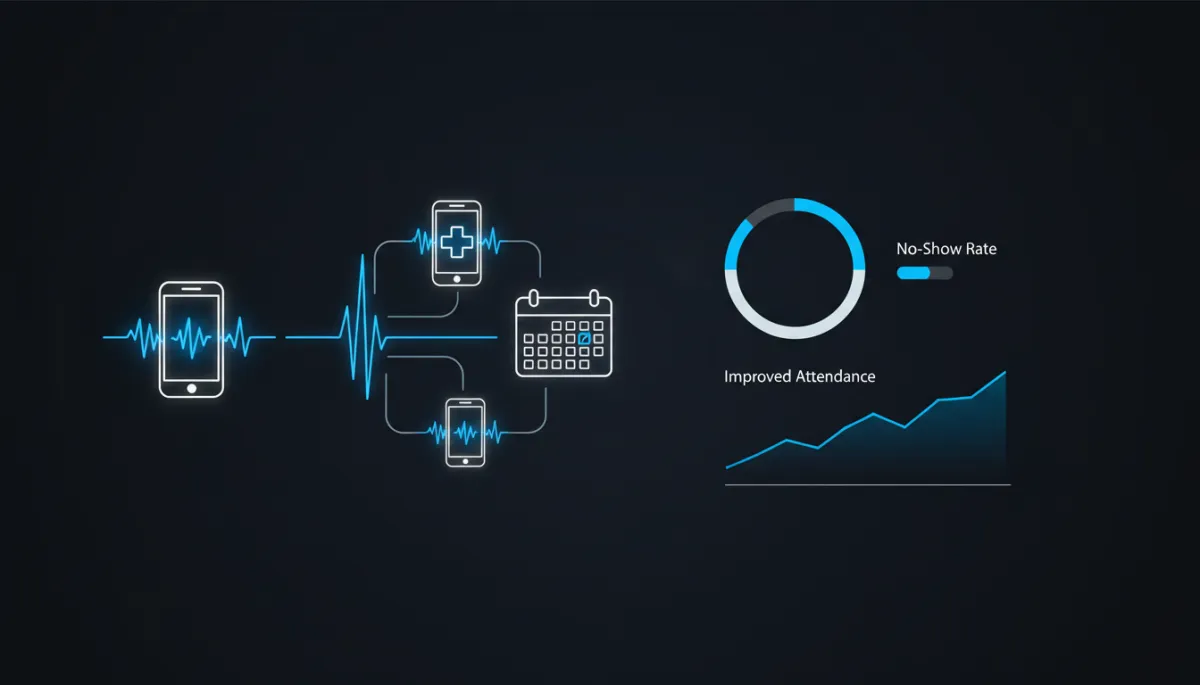
Clinics using voice AI report 25–45% fewer no-shows and higher staff efficiency.
The ROI Case: 300–600% Returns in Year One
When you combine reduced no-shows, reclaimed staff time, and higher patient throughput, the financial case for voice AI for medical practices becomes compelling. Case studies across internal medicine and specialty clinics show 300–600% ROI in the first year, with some deployments achieving even higher multiples when baseline no-show rates are high.
Cost Comparison: AI Voice vs. Human Staffing
A typical AI voice solution for a clinic might cost between $3,650 and $53,000 per year, depending on call volume, features, and number of locations. To match the same level of outbound calling, reminder management, and after-hours coverage with human staff, many practices would need the equivalent of 1–3 full-time employees, costing roughly $127,500 to $240,000 per year in salaries and benefits.
In other words, clinics can often achieve the same or better coverage at a fraction of the cost, while freeing existing staff to focus on complex, high-touch interactions that AI is not designed to handle.
System-Level Impact: Toward $150 Billion in Savings
At a system level, analysts project that widespread adoption of AI-driven reminders and scheduling could help healthcare providers collectively avoid up to $150 billion in wasted cost by 2026, largely by reducing missed appointments, improving care coordination, and preventing avoidable complications. For individual practices, even a modest reduction in no-shows—say, from 18% to 10%—can translate into hundreds of thousands of dollars in recovered revenue each year.
Working Alongside Clinical Teams: The 80/20 Split
A common concern among clinic leaders is whether an AI voice agent will “replace” front-desk staff. In practice, the most successful deployments follow an 80/20 model:
- The AI handles around 80% of routine, repetitive interactions—confirmation calls, simple rescheduling, standard pre-screening, and basic follow-up.
- Human staff focus on the remaining 20% of complex or sensitive cases—patients who are distressed, have multiple comorbidities, or require nuanced clinical judgment.
Calls can be escalated seamlessly from the AI to a live agent when certain triggers are met, such as a patient expressing confusion, dissatisfaction, or potential clinical risk. This hybrid approach preserves the human touch where it matters most, while ensuring no routine task falls through the cracks.
Implementation Phases: From Audit to Expansion
Successful clinic automation with voice AI is not about switching everything on overnight. It follows a structured rollout that minimizes disruption and builds confidence among staff and patients.
Phase 1: Audit
Begin by reviewing your current scheduling and communication processes:
- Baseline no-show and cancellation rates by provider and visit type.
- How and when reminders are currently sent (if at all).
- Staff time spent on outbound calls and manual rescheduling.
This audit informs your business case and clarifies where an AI voice agent will have the greatest impact.
Phase 2: Setup and Integration
Next, your technology partner configures the AI to work with your practice management system or EHR. This includes:
- Defining call scripts, escalation rules, and clinic-specific policies.
- Setting up secure data connections and user permissions.
- Training staff on how to monitor calls, review logs, and handle escalations.
Phase 3: Launch with a Focused Use Case
Most clinics start with a single, high-impact workflow—typically AI appointment reminders for a subset of visit types. This controlled launch allows you to:
- Measure early changes in confirmation and no-show rates.
- Collect feedback from staff and patients on call quality and tone.
- Fine-tune scripts and timing based on real-world behavior.
Phase 4: Expand and Optimize
Once the initial workflow is stable, you can expand into pre-screening, post-visit follow-up, and refill reminders. Over time, data from your AI system can highlight:
- Which patient segments respond best to voice vs. SMS or email.
- Optimal reminder intervals for different specialties or procedures.
- Additional opportunities to automate low-risk, high-volume workflows.
Compliance, Privacy, and Patient Trust
Any AI voice agent healthcare deployment must be grounded in regulatory compliance and ethical handling of patient data. Reputable providers design their platforms to support HIPAA and other regional privacy frameworks, with safeguards such as:
- Encrypted transmission and storage of protected health information (PHI).
- Role-based access controls and detailed audit logs of every interaction.
- Clear opt-in and opt-out mechanisms for automated outreach.
Patient trust also depends on transparency. Best practice is to ensure that the AI clearly identifies itself as an automated assistant, explains why it is calling, and offers a straightforward path to speak with a human. Many patients appreciate timely reminders and the convenience of rescheduling without waiting on hold—especially when the system is respectful, accurate, and easy to understand.
Next Steps: Evaluate AI Voice for Your Clinic
If your clinic is experiencing persistent no-shows, long waitlists, or overwhelmed front-desk teams, it is an ideal time to explore voice AI for medical practices. Start by quantifying your current no-show rate and estimating the revenue tied to each missed appointment. Even a 25–30% reduction can transform your financial performance and patient experience.
To see how conversational automation can extend beyond voice into web chat and messaging, review the AI solutions and resources at nexurate.com/aichatbot. For a tailored view of where automation can make the biggest difference on your own site and patient journey, claim your complimentary audit:
Call to Action:Get a Free SEO and Website Audit at nexurate.com and uncover quick wins to attract more patients, reduce no-shows, and streamline your digital front door.
SEO Title: How AI Voice Agents Help Healthcare Clinics Cut No-Shows by 50%
Meta Description: Discover how an AI voice agent for healthcare can reduce patient no-shows by up to 50%, boost ROI by 300–600% in year one, and relieve front-desk staff through automated appointment reminders, pre-screening, and follow-up.
Primary Keyword: AI voice agent for healthcare
