AI Automation vs Sales Rep: SME Growth 2026
Sales Strategy, AI Automation, SME Growth
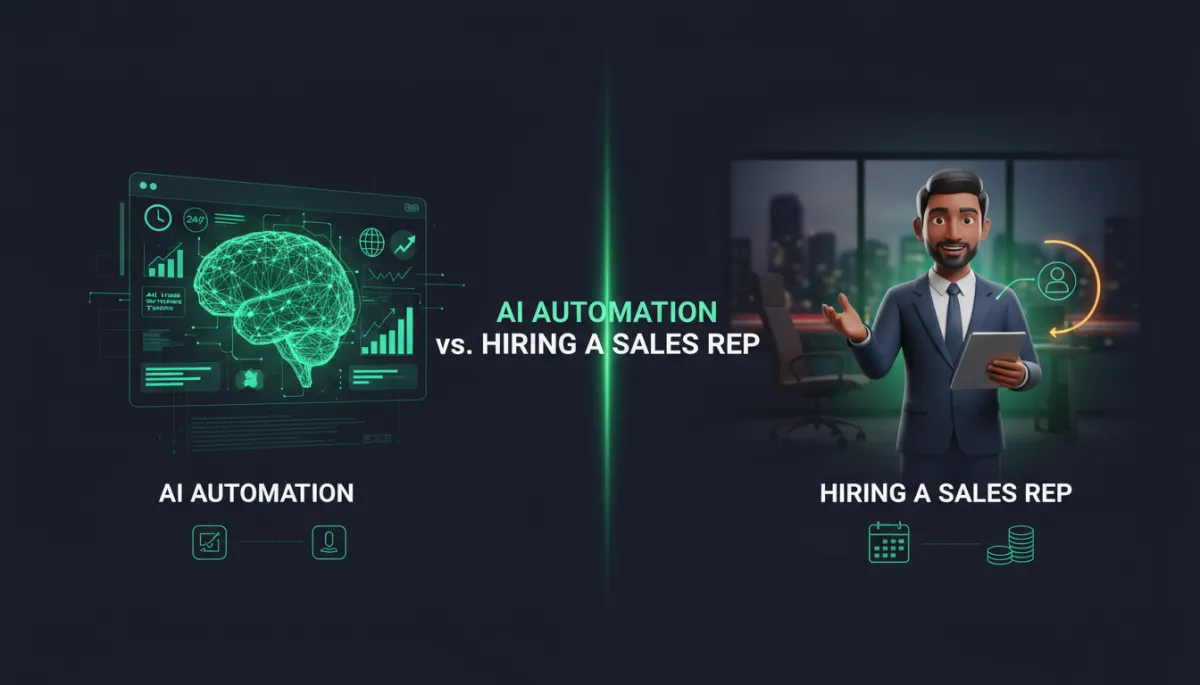
AI Automation vs. Hiring a Sales Rep: Which Option Grows Your SME Faster in 2026?
As an SME founder in India, the UAE, the UK, the US, or Australia, you know growth depends on one thing: turning more leads into predictable revenue. The question is no longer whether to invest, but where to invest first — in AI automation or in your first sales representative. This article offers an objective, data-backed comparison of both paths so you can decide which one grows your business faster in 2026.
SEO Title: AI Automation vs. Hiring a Sales Rep: Which Grows Your SME Faster in 2026? | Meta Description: Detailed comparison of AI automation systems vs. hiring a sales development rep for SMEs — covering cost, speed, scalability, and which option fits different business stages. | Primary Keyword: AI automation vs hiring sales rep | Secondary Keywords: should I hire a salesperson or use AI, AI vs human sales, SME sales team vs automation, cost of sales rep vs CRM automation | URL Slug: ai-automation-vs-hiring-sales-rep-sme | Author: Nexurate Technologies | Status: PUBLISHED
Why This Decision Matters More in 2026
AI adoption among small and medium businesses has surged. Recent studies show that well over half of SMEs in many markets already use AI tools for marketing, customer service, or finance, and adoption is still climbing. At the same time, sales representative salaries have risen across India, the UAE, the UK, the US, and Australia, while recruitment has become more competitive and time-consuming.
Against this backdrop, the question “AI automation vs hiring sales rep” has become a strategic fork in the road. This is not a theoretical debate about AI vs human sales; it is a practical, financial, and operational decision that will shape how quickly and efficiently your SME can scale in 2026 and beyond.
1. Cost: What You Really Pay for Sales Capacity
When founders ask, “Should I hire a salesperson or use AI?” cost is usually the first lens they use. But looking only at base salary hides major hidden expenses: recruitment, benefits, ramp time, and the opportunity cost of slow results. Below is a simplified comparison of fully loaded monthly salary bands for a Sales Development Representative (SDR) versus a typical AI automation system subscription in 2026.
Market SDR Fully Loaded Monthly Cost Typical AI Automation Monthly Cost* India ₹45,000–₹1,12,000 ~₹10,000–₹40,000 UAE AED 6,000–15,600 ~AED 1,500–5,000 UK £3,125–£5,400 ~£400–£1,500 US $5,200–$9,800 ~$400–$2,000 Australia AUD 6,875–11,050 ~AUD 600–2,500
*AI estimates are indicative SaaS ranges for sales automation and CRM workflows in 2026; actual pricing varies by vendor, volume, and customisation.
The Hidden Cost of Hiring: Recruitment, Ramp, and Risk
Beyond monthly salary, hiring your first SDR typically involves:
Recruitment fees: 15–20% of first-year salary paid to agencies or internal hiring costs (job boards, time spent interviewing, assessments).
Onboarding and training: 2–4 weeks of founder or manager time to transfer product knowledge, messaging, and tools.
Ramp period: 60–90 days before the rep reliably hits quota and contributes net-positive revenue.
When you factor in 15–20% recruitment fees, plus two to three months of underperformance during ramp, the real first-year cost of a sales rep is often 1.3–1.5x their base compensation. In contrast, AI-based sales automation platforms typically:
Require no recruitment fees.
Can be deployed on a monthly subscription, with the option to scale up or down.
Deliver value as soon as they go live, without a 90-day ramp.
📌 Key takeaway: In every market analysed, AI automation systems cost a fraction of a single SDR’s fully loaded salary, especially when you factor in recruitment and ramp time.
2. Speed of Deployment: When Do You See First Results?
Time-to-value is critical for SMEs. A long delay between investment and results can strain cash flow and founder confidence. Here is how the timelines compare.
Hiring a Sales Rep: 3–5 Months to First Meaningful Impact
4–8 weeks recruitment: defining the role, advertising, screening CVs, interviews, offers, and notice periods.
2–4 weeks onboarding: product training, CRM setup, territory definition, messaging practice, and compliance checks.
60–90 days ramp: learning from lost deals, refining pitch, building pipeline from scratch, and reaching full productivity.
From the day you decide to hire to the day you see a steady stream of qualified opportunities, you are typically looking at 3–5 months. During this period, you are paying salary and benefits but not yet seeing full revenue impact.
AI Automation: 2–4 Weeks to Live System
Modern AI sales automation tools — especially plug-and-play systems designed for SMEs — can be configured and deployed in 2–4 weeks. A typical rollout with a provider like Nexurate might include:
Mapping your existing lead sources (website, forms, inbound email, WhatsApp, LinkedIn, CRM).
Defining qualification criteria, scoring rules, and routing logic.
Training AI workflows on your messaging, FAQs, and objection handling.
Launching in a controlled pilot and iterating within days, not months.
📌 Key takeaway: If your priority is speed, AI automation gets you from decision to measurable activity in weeks, not months. This is particularly important for SMEs operating with short cash runways or seasonal demand.
3. Availability and Coverage: Who Works When You Sleep?
SMEs in India, the UAE, the UK, the US, and Australia increasingly sell across borders and time zones. This makes availability a critical factor in the AI automation vs hiring sales rep decision.
Human Sales Rep: Limited Hours, Single Time Zone Focus
A full-time sales rep is typically available around 40–45 hours per week. When you account for internal meetings, admin, and non-selling time, most studies estimate that only ~22% of the week is spent in actual selling conversations. They are usually anchored to one primary time zone, with limited ability to cover late-night or early-morning leads from other regions without burnout or overtime costs.
AI Automation: 24/7, All Time Zones, Unlimited Conversations
AI systems do not sleep, take breaks, or ask for holidays. Once deployed, they can:
Operate 100% of the week — 24 hours a day, 7 days a week, including weekends and public holidays in multiple countries.
Engage leads from any time zone at the moment they enquire, rather than waiting for office hours.
Handle unlimited simultaneous conversations without queueing or dropped leads.
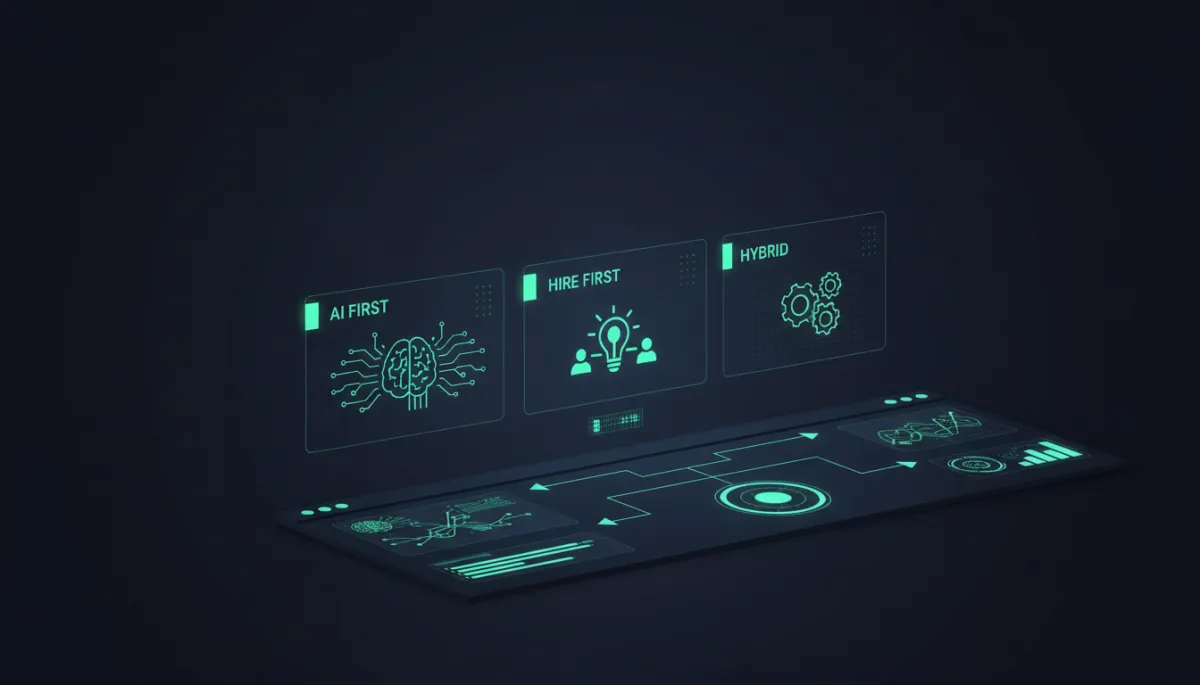
A clear decision matrix helps SME founders align sales investment with deal size and lead volume.
4. Consistency and Quality: Precision vs. Human Nuance
Quality of customer interaction is not just about what is said; it is also about how consistently it is delivered. Here, AI and humans complement each other in different ways.
Where AI Wins: Consistency at Scale
AI delivers the same quality at 3 a.m. as at 10 a.m. — no bad days, no fatigue, no mood swings.
Every lead is asked the same qualifying questions, in the right order, ensuring clean data and fair scoring.
Messaging can be centrally controlled and updated once, then instantly rolled out across all conversations.
Where Humans Win: Nuance and Complex Negotiations
In complex B2B or enterprise sales cycles — especially for deals above ₹10L / $50K — buyers expect nuanced, relationship-driven conversations that adapt to politics, history, and subtle cues. Human reps are better at:
Reading emotion, hesitation, and unstated objections in voice or body language.
Navigating internal stakeholder dynamics and informal decision-makers.
Co-creating bespoke solutions and pricing structures that require creativity and negotiation.
📌 Key takeaway: AI excels at delivering reliable, on-brand qualification and nurturing. Humans excel at complex, high-stakes conversations where nuance and trust matter most.
5. Scalability: How Do You Go from 50 to 5,000 Leads per Month?
Growth creates a new problem: scale. What works for 50 inbound leads per month often breaks at 500 or 5,000. The SME sales team vs automation question becomes most visible here.
Human Sales Teams: Linear Scaling, Rising Complexity
To handle more leads, you must hire more reps, with all the associated recruitment, training, and management overhead.
Managerial complexity increases: performance management, territory conflicts, and culture issues consume leadership time.
Costs scale linearly — double the leads often means double the headcount.
AI Automation: Non-Linear Scaling with Minimal Marginal Cost
A well-designed AI system can comfortably scale from 50 to 5,000 leads per month with little to no additional cost. You may occasionally upgrade your subscription tier or infrastructure plan, but you do not need to recruit, onboard, and manage dozens of new people at the same pace. This is particularly powerful for SMEs running campaigns, events, or seasonal promotions where lead volume spikes temporarily.
📌 Key takeaway: If your growth strategy involves large, sudden jumps in lead volume — for example, digital ads, partnerships, or marketplace listings — AI automation offers a smoother, more predictable scaling path than pure headcount growth.
6. Intelligence and Relationship Building: Who Should Own the Customer?
The most strategic dimension in the AI vs human sales debate is not cost or speed; it is who owns the relationship with your customer and what type of intelligence that relationship requires.
Where Humans Win: Deep, High-Value Relationships
For high-ticket, strategic deals — think contracts above ₹10L / $50K with multiple stakeholders and long sales cycles — humans are still superior. A skilled rep can:
Build trust over months of conversations, workshops, and on-site visits.
Understand political undercurrents, budget cycles, and internal champions or blockers.
Co-create a roadmap and commercial structure that feels fair to both sides.
Where AI Wins: Structured, Repeatable Qualification
For deals under ₹5L / $10K, where the sales process is largely repeatable — discovery, demo, proposal, follow-up — AI is extremely effective at:
Asking structured questions to qualify budget, authority, need, and timing (BANT or similar frameworks).
Nurturing leads with personalised, timely content based on their behaviour and responses.
Handing over only sales-ready, high-intent leads to a human closer — or closing directly for simple, transactional offers.
📌 Key takeaway: Humans should own deep, strategic relationships. AI should own structured, repeatable qualification and early-stage nurturing — especially when volumes are high and deal sizes are moderate.
The Hiring Risk Nobody Talks About
There is a structural risk in hiring that rarely appears in spreadsheets: what happens if your rep leaves or underperforms? For an SME, this can be existential.
If your first rep underperforms, you may not know whether the problem is your offer, your market, or the individual’s skills. You lose 6–12 months before you can confidently diagnose the issue.
If they leave, they often take with them relationship knowledge — which accounts are warm, who the champions are, what objections were raised — even if your CRM is well maintained.
If they excel, you become dependent on a single person for revenue, creating concentration risk.
AI automation systems, by contrast, codify your sales knowledge into workflows, templates, and data. When you improve your messaging or targeting, that improvement is instantly applied across every interaction. There is no risk of key knowledge walking out of the door.
Decision Matrix: AI First, Hire First, or Hybrid?
To move from theory to decision, use the following matrix as a practical guide. It summarises when AI, humans, or a hybrid approach is likely to be the best fit for your SME in 2026.
Choose AI First If:
You generate 30+ leads per month from your website, ads, or partnerships.
Your typical deal size is under ₹5L / $10K, with a relatively repeatable sales process (demo, proposal, close).
You sell across multiple time zones or countries and cannot staff every region yet.
You currently have no dedicated sales function; founders or generalists handle sales part-time.
Your close rate is below 20% and you suspect leads are slipping through the cracks or not being followed up consistently.
Choose to Hire First If:
Your deals are typically above ₹10L / $50K, with multi-month cycles and multiple decision-makers.
Each sale is highly bespoke — for example, custom implementation, integration, or solution design for each client.
You already have a steady but small stream of highly qualified leads and need a human to own relationships and close, not just qualify.
Best of Both Worlds: AI + One SDR
For many SMEs, the optimal 2026 strategy is a hybrid model:
Use AI automation to handle 80% of the lead journey — capture, qualify, nurture, and schedule.
Hire one strong SDR or closer to focus only on hot, AI-qualified leads, where human judgment and persuasion add the most value.
📌 Key takeaway: You do not have to choose between AI and humans. The most efficient SMEs use AI to create a predictable, scalable pipeline and humans to close the highest-value opportunities.
FAQ: Common Questions from SME Founders
1. Can AI qualify leads as well as humans?
For structured, repeatable qualification, yes — and often better. AI can ask every lead the right questions, log every answer, and apply qualification rules consistently. It never forgets to follow up and never mis-logs a field. Where humans still have an edge is in ambiguous situations with incomplete information or political complexity. The most effective approach is to let AI handle first-line qualification and escalate edge cases to humans.
2. What if my leads want to talk to a human?
Many leads are comfortable with AI-powered chat, especially for initial questions and scheduling. However, some will explicitly request a human. A well-designed system should make that handoff instant — allowing the lead to book a call, start a live chat, or receive a personalised email from a human rep. AI is not a wall between you and your customers; it is a routing and acceleration layer that gets serious buyers to the right person faster.
3. Is this a permanent choice, or can I switch later?
This is not a permanent either–or decision. Many SMEs start with AI automation to validate their funnel, improve data quality, and increase lead-to-opportunity conversion. Once they have a predictable flow of qualified leads, they then hire one or more reps to focus on closing and account expansion. Others start with a human and later add AI to remove manual tasks and scale. The key is to design your systems so that AI and humans can co-exist and share the same CRM and data.
4. How do I measure ROI on AI vs a sales rep?
For both options, focus on a small set of leading indicators:
Conversion from lead to qualified opportunity.
Average time from enquiry to first meaningful response.
Cost per qualified opportunity generated.
Close rate and average deal size.
Compare these metrics before and after implementing AI or hiring your rep. In many SMEs, AI quickly improves the top-of-funnel metrics, while humans improve bottom-of-funnel outcomes when focused on the right opportunities.
Making Your 2026 Decision: A Practical Next Step
Deciding between AI automation vs hiring a sales rep is ultimately about matching your growth constraints with the right tool. If you are constrained by time, consistency, and coverage, AI will usually move the needle faster. If you are constrained by relationship depth and deal complexity, a skilled rep is often the better first hire. For most SMEs, the most resilient path is to combine both: let AI build a reliable, always-on lead engine, and let humans focus where their judgment and empathy create the most value.
CTA: Explore Nexurate’s AI Automation Systems
If you are an SME founder in India, the UAE, the UK, the US, or Australia and you are weighing whether to build your first sales team or invest in automation, you do not have to guess. Nexurate Technologies designs AI-powered sales automation systems specifically for SMEs — built to integrate with your existing CRM, qualify leads 24/7 across time zones, and hand over hot opportunities to you or your reps.
To see how AI could support your growth targets in 2026 — whether as your first sales engine or as a force multiplier for a small team — explore Nexurate’s AI Automation Systems today and schedule a consultation tailored to your market, deal size, and sales model.
